

Neuroscience
Unlock Your Mind.
The subject of neuroscience - the science of the nervous system and brain structure and function - is a rapidly growing science that has become established within many different scientific disciplines. Our Neuroscience program begins with a rigorous core of basic science classes and laboratories, moving on to a core of more advanced courses. All students are educated in the breadth of the subject, but will eventually choose one of three concentrations – systems, behavioral, or computational.
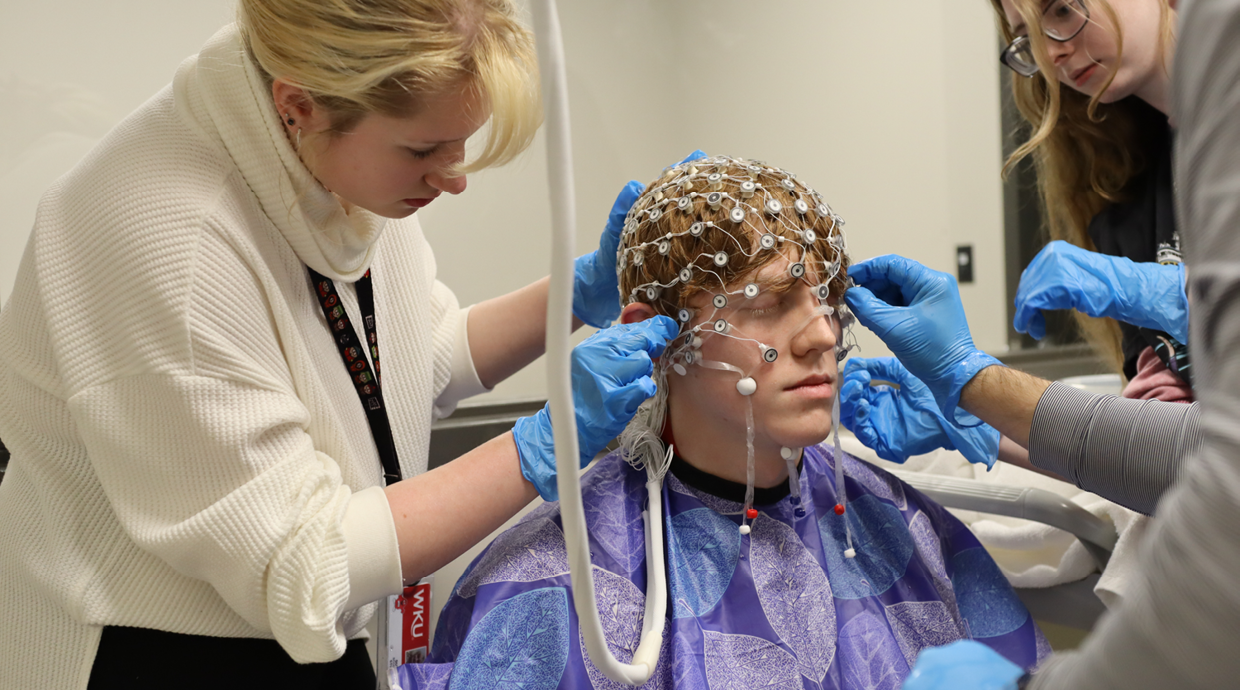
As a strong natural science degree with a large hands-on component, our Neuroscience program educates students to be lifelong innovators and problem-solvers. We offer three concentrations that represent natural pipelines to a variety of careers and postgraduate degree options.
- The Systems concentration can lead to options such as in-depth graduate study in neuroscience or clinical psychopharmacology or a career in the pharmaceutical industry. This concentration may also be supplemented with additional coursework as a pre-health professions option for those interested in medical school.
- The Behavioral concentration can progress to graduate study in cognitive neuroscience or psychiatry.
- Students pursuing the Computational concentration could find career options such as artificial intelligence, medical data analytics, healthcare analytics, prosthetics, or robotics.
|
OGDEN COLLEGE OF SCIENCE & ENGINEERING Bachelor of Science |

- Neuroscience Program Coordinator
- michael.smith1@wku.edu
- KTH 3035
- 270-745-3696

2021 WKU Graduate
Seth Hoffman was first introduced to neuroscience through Dr. Michael Smith’s Neurobiology course in 2019. He completed his Honors thesis in the Smith lab, which examined previously undescribed vibratory communication occurring between mudskippers (unique fishes known for spending much of their time out of water). He is now working on a Ph.D. in Neuroscience at Brigham Young University in Dr. Jeff Edwards' lab. Seth is interested in understanding inhibitory plasticity in the ventral tegmental area (VTA) of the brain, to better understand the effects of drug exposure to reverse drug dependence. GABA (an inhibitory neurotransmitter) cells directly control dopamine (DA) release in the VTA, making their plasticity extremely important for understanding how reward conditioning works. Using labeling techniques together with whole-cell electrophysiology, Seth identifies VTA GABA cells that innervate local VTA DA cells and record their shifts in neural sensitivity.
Some of the links on this page may require additional software to view.